Electro-permanent lifting magnets are designed to combine the best of both worlds: the reliability of permanent magnets and the flexibility of electromagnets. The short answer to how they work: they only use electricity to switch on and off, but the lifting force itself comes entirely from permanent magnets. That means your load stays secure, even if the power fails.
The working principle in simple words
An electro-permanent lifting magnet has two sets of magnets:
- Neodymium magnets: these hard magnets keep their magnetic orientation.
- AlNiCo magnets: soft magnets that can be reversed by a short current pulse.
When both sets of magnets are aligned in the same direction, the magnetic flux is strong and the magnet is ON. When they are opposed, the magnetic fields cancel each other out, and the magnet is OFF.
The key detail: electricity is only needed for the switching pulse. Once the magnet is on, it requires no further power to keep holding the load
Why electro-permanent lifting magnets stand out
Electro-permanent lifting magnets are bistable. They don’t need continuous power to keep holding or releasing. Electricity is only required for the switching pulse.
- Power failure safety: the permanent magnets provide holding force, so a load cannot drop if electricity is lost.
- Energy efficiency: no continuous energy consumption during lifting.
- Ease of use: switching can be done at the push of a button, or even by wireless remote control.
Adjustable lifting capacity: lift a single thin sheet from a stack without pulling up multiple layers.
Where they are used
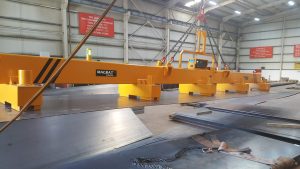
Electro-permanent lifting magnets are widely applied in industries that rely on moving heavy ferromagnetic materials such as steel plates, slabs, billets, and coils. You see them in:
- Steel and construction sites (lifting steelplates, profiles, slabs, coils)
- Shipyards and heavy machinery production
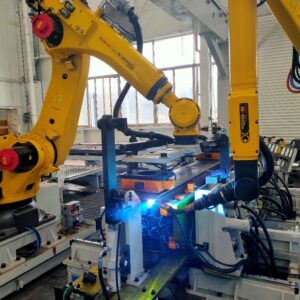
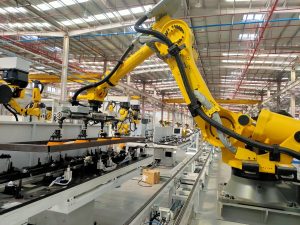
- Automated processes with lifting beams or robotic systems
- Plastic injection companies for Quick changing molds and dies
Limitations to keep in mind
- Air gap sensitivity: if the load surface is rough, rusty, or uneven, the lifting capacity drops quickly.
- Higher cost: compared to permanent or simple electro lifting magnets, electro-permanent systems are usually more expensive.
Häufig gestellte Fragen
A permanent lifting magnet uses magnetized material to create a constant magnetic field. It can often be switched on and off manually with a lever.
It combines permanent magnets with reversible magnets controlled by a current pulse. This allows switching without needing continuous power.
They are made from materials with high intrinsic coercive force. This means their magnetic orientation is stable and does not fade easily.
They use a mechanical or electrical system to change the orientation of magnets inside the device, switching between attraction and release.
In normal conditions, a permanent magnet can retain most of its strength for decades. Electro-permanent magnets can safely hold loads for many years without power.